
UN Educational, Scientific and Cultural Organization
Global Education First Initiative
UN Population Fund: Comprehensive sexuality education
UN Office of the Secretary General’s Envoy on Youth
- By 2030, ensure that all girls and boys complete free, equitable and quality primary and secondary education leading to relevant and Goal-4 effective learning outcomes
- By 2030, ensure that all girls and boys have access to quality early childhood development, care and preprimary education so that they are ready for primary education
- By 2030, ensure equal access for all women and men to affordable and quality technical, vocational and tertiary education, including university
- By 2030, substantially increase the number of youth and adults who have relevant skills, including technical and vocational skills, for employment, decent jobs and entrepreneurship
- By 2030, eliminate gender disparities in education and ensure equal access to all levels of education and vocational training for the vulnerable, including persons with disabilities, indigenous peoples and children in vulnerable situations
- By 2030, ensure that all youth and a substantial proportion of adults, both men and women, achieve literacy and numeracy
- By 2030, ensure that all learners acquire the knowledge and skills needed to promote sustainable development, including, among others, through education for sustainable development and sustainable lifestyles, human rights, gender equality, promotion of a culture of peace and non-violence, global citizenship and appreciation of cultural diversity and of culture’s contribution to sustainable development
- Build and upgrade education facilities that are child, disability and gender sensitive and provide safe, nonviolent, inclusive and effective learning environments for all
- By 2020, substantially expand globally the number of scholarships available to developing countries, in particular least developed countries, small island developing States and African countries, for enrolment in higher education, including vocational training and information and communications technology, technical, engineering and scientific programmes, in developed countries and other developing countries
- By 2030, substantially increase the supply of qualified teachers, including through international cooperation for teacher training in developing countries, especially least developed countries and small island developing states.
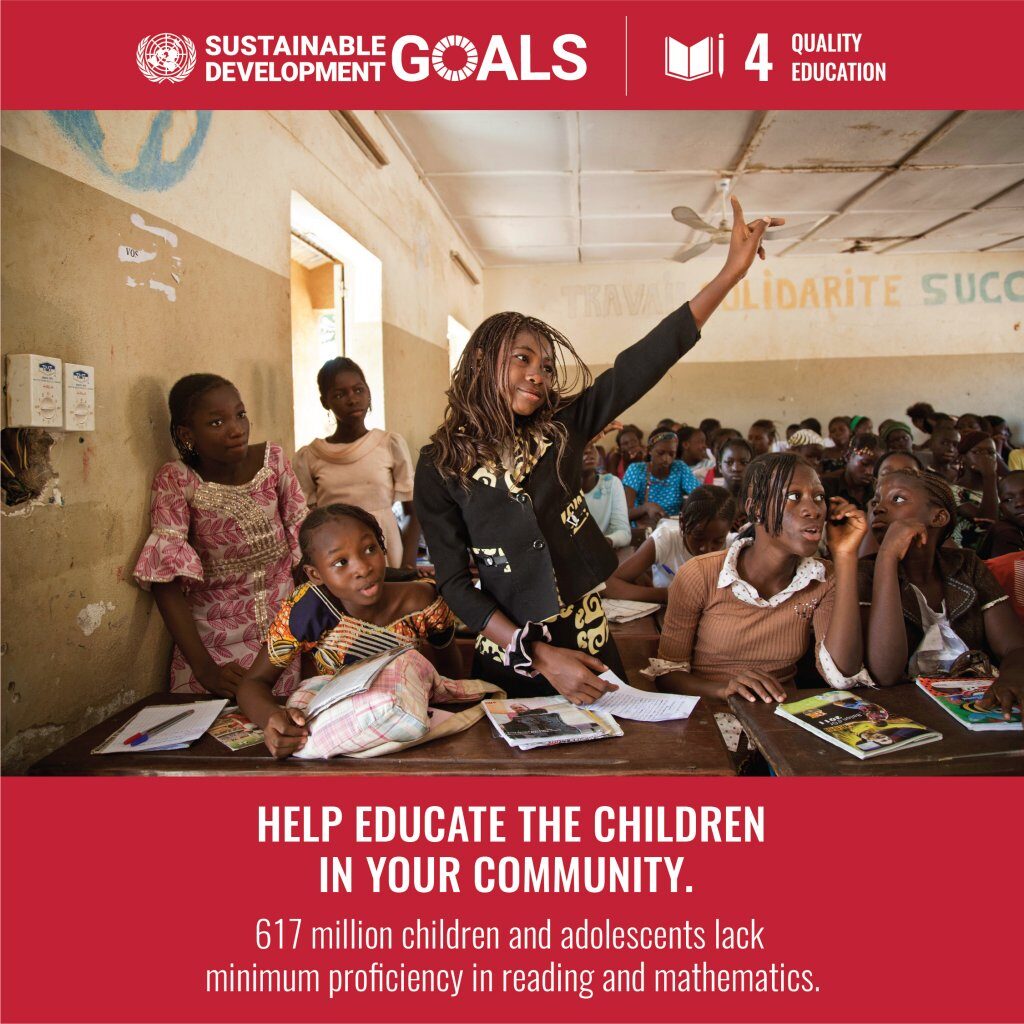
Education enables upward socioeconomic mobility and is a key to escaping poverty. Over the past decade, major progress was made towards increasing access to education and school enrollment rates at all levels, particularly for girls. Nevertheless, “about 260 million children were still out of school” in 2018 — nearly one fifth of the global population in that age group. And more than half of all children and adolescents worldwide are not meeting minimum proficiency standards in reading and mathematics.
In 2020, as the COVID-19 pandemic spread across the globe, a majority of countries announced the temporary closure of schools, impacting more than 91 per cent of students worldwide. By April 2020, close to “1.6 billion children and youth were out of school.” And nearly “369 million children who rely on school meals” needed to look to other sources for daily nutrition.
Never before have so many children been out of school at the same time, disrupting learning and upending lives, especially the most vulnerable and marginalised. The global pandemic has far-reaching consequences that may jeopardize hard won gains made in improving global education.
COVID-19 response
In an effort to foster international collaboration and ensure that education never stops, UNESCO is mounting a response with a set of initiatives that include the global monitoring of national and localized school closures.
To protect the well-being of children and ensure they have access to continued learning, UNESCO in March 2020 launched the COVID-19 Global Education Coalition, a multi-sector partnership between the UN family, civil society organizations, media and IT partners to design and deploy innovative solutions. Together they help countries tackle content and connectivity gaps, and facilitate inclusive learning opportunities for children and youth during this period of sudden and unprecedented educational disruption.
Specifically, the Global Education Coalition aims to:
- Help countries in mobilizing resources and implementing innovative and context-appropriate solutions to provide education remotely, leveraging hi-tech, low-tech and no-tech approaches;
- Seek equitable solutions and universal access;
- Ensure coordinated responses and avoid overlapping efforts;
- Facilitate the return of students to school when they reopen to avoid an upsurge in dropout rates.
UNICEF also scaled up its work in 145 low- and middle-income countries to support governments and education partners in developing plans for a rapid, system-wide response including alternative learning programmes and mental health support.