Experiencia Ambientalia empowers rural and Indigenous youth and teachers around Laguna Mar Chiquita, South America's largest saline lake, to become wetland conservation leaders. Since 2021, 800+ students and teachers from 20+ towns have created 78 youth-led projects.
Project Objective
To strengthen the knowledge, appreciation, and long-term care of Laguna Mar Chiquita and other wetlands across Argentina and the Western Hemisphere by empowering youth and educators to become environmental leaders who understand local challenges, engage their communities, and co-create sustainable solutions that protect wetland ecosystems and support resilient territories.
Executive Summary
Experiencia Ambientalia is an international environmental education and youth leadership program developed by Manomet Conservation Sciences, the Western Hemisphere Shorebird Reserve Network (WHSRN) Executive Office, and Fundación Líderes de Ansenuza. Based in Argentina and centered on Laguna Mar Chiquita, South America’s largest saline lake and a globally significant wetland, the program empowers underprivileged students and educators from rural and Indigenous communities to engage with their local ecosystems and take an active role in their protection.
Through hands-on learning, community-based projects, Experiencia Ambientalia equips young people with the skills to design and implement projects that advance wetland conservation while strengthening leadership and community engagement. Since 2021, the program has engaged 800+ students and teachers from over 20 rural towns, resulting in 78 locally designed projects that support wetland conservation and sustainable development.
Building on this experience, the program is expanding through partnerships with local organizations in other wetland regions across the Americas. By adapting its educational model to different territories, including sites in Argentina and the United States, like Mono Lake, Great Salt Lake and Laguna de los Pozuelos.
Background
Laguna Mar Chiquita is a wetland of hemispheric importance, recognized as a Ramsar site, part of the Western Hemisphere Shorebird Reserve Network (WHSRN), and recently designated Ansenuza National Park. It supports over 380 bird species, including migratory shorebirds that connect ecosystems and communities across continents.
Despite living in this extraordinary landscape, many young people in surrounding rural and Indigenous communities have limited access to environmental education and few opportunities to engage meaningfully with their own territory. This disconnect weakens long-term conservation outcomes and limits youth participation in community decision-making.
Experiencia Ambientalia was created to address this gap. Developed by Manomet Conservation Sciences, the WHSRN Executive Office, and Fundación Líderes de Ansenuza, the program integrates scientific knowledge, traditional knowledge, and active learning to reconnect youth with their environment and empower them to act locally while thinking globally.
Among the migratory species that depend on Laguna Mar Chiquita is the Wilson’s Phalarope, a small shorebird whose annual journey links saline lakes across the Americas. The same birds that gather at Ansenuza during migration also rely on wetlands in other countries, creating a natural bridge between distant communities.
Implementation Plan
Since 2021, Experiencia Ambientalia has been implemented annually, running from May to November, and combining virtual and in-person learning experiences.
Call for applications: Open, inclusive calls across towns surrounding Mar Chiquita.
Project Design: youth teams identify local socio-environmental challenges and design projects focused on conservation, research or sustainable businesses. Throughout the year, teams receive ongoing technical and educational support, including personalized mentoring, connections with scientific and community advisors, and access to small grants or materials to support project implementation.
Field Trips: Exploratory visits to natural areas that allow participants to observe local biodiversity, understand environmental issues firsthand, and strengthen their connection with the territory.
International and Community Events: Monthly activities that connect Mar Chiquita students with youth from different countries and communities, offering virtual exchanges, shared workshops, and collaborative actions that build a broader perspective and a sense of hemispheric community.
Project Fair and Environmental Leaders Forum: The annual cycle culminates in a Project Fair, where youth publicly present their projects to their communities, and a Leadership Forum, bringing together outstanding participants for intensive workshops, recognition, and exchange.
Outcomes
Since its launch in 2021, Experiencia Ambientalia has delivered measurable environmental and educational outcomes in the Ansenuza region and beyond:
800+ students and educators engaged through annual program cycles
20+ rural towns and communities participating around Laguna Mar Chiquita
78 youth-led projects designed and implemented
5,000+ community members reached through local activities, campaigns, and events
3 International exchange trips between students from Mar Chiquita and Mono Lake.
Establishment of a replicable, place-based education model rooted in local realities and adaptable to other wetland contexts.
Contribution to long-term wetland protection and sustainable development by building local capacity, trust, and youth leadership in a region of global ecological importance.
Strengthened international connections through exchanges with communities in Argentina, Chile, Ecuador, and the United States, fostering a shared hemispheric perspective on wetland conservation.
Partnerships
Experiencia Ambientalia is implemented through a strong network of local, national, and international partnerships with:
Local schools and educators
National Park Authorities
Local and provincial governments
Local businesses
Community and Indigenous organizations
International conservation organizations
Sustainability Vision
Experiencia Ambientalia is an established, long-term program in the Ansenuza region, sustained through annual implementation, strong relationships with schools and communities, and coordination with local conservation and education actors. By centering educators as facilitators and empowering youth as leaders, the program ensures continuity beyond individual project cycles.
At the same time, the experience gained in Ansenuza has enabled the development of a replicable, place-based educational model, supported by strategic alliances and growing international collaboration, allowing local action to contribute to a broader hemispheric effort to protect interconnected wetland ecosystems.
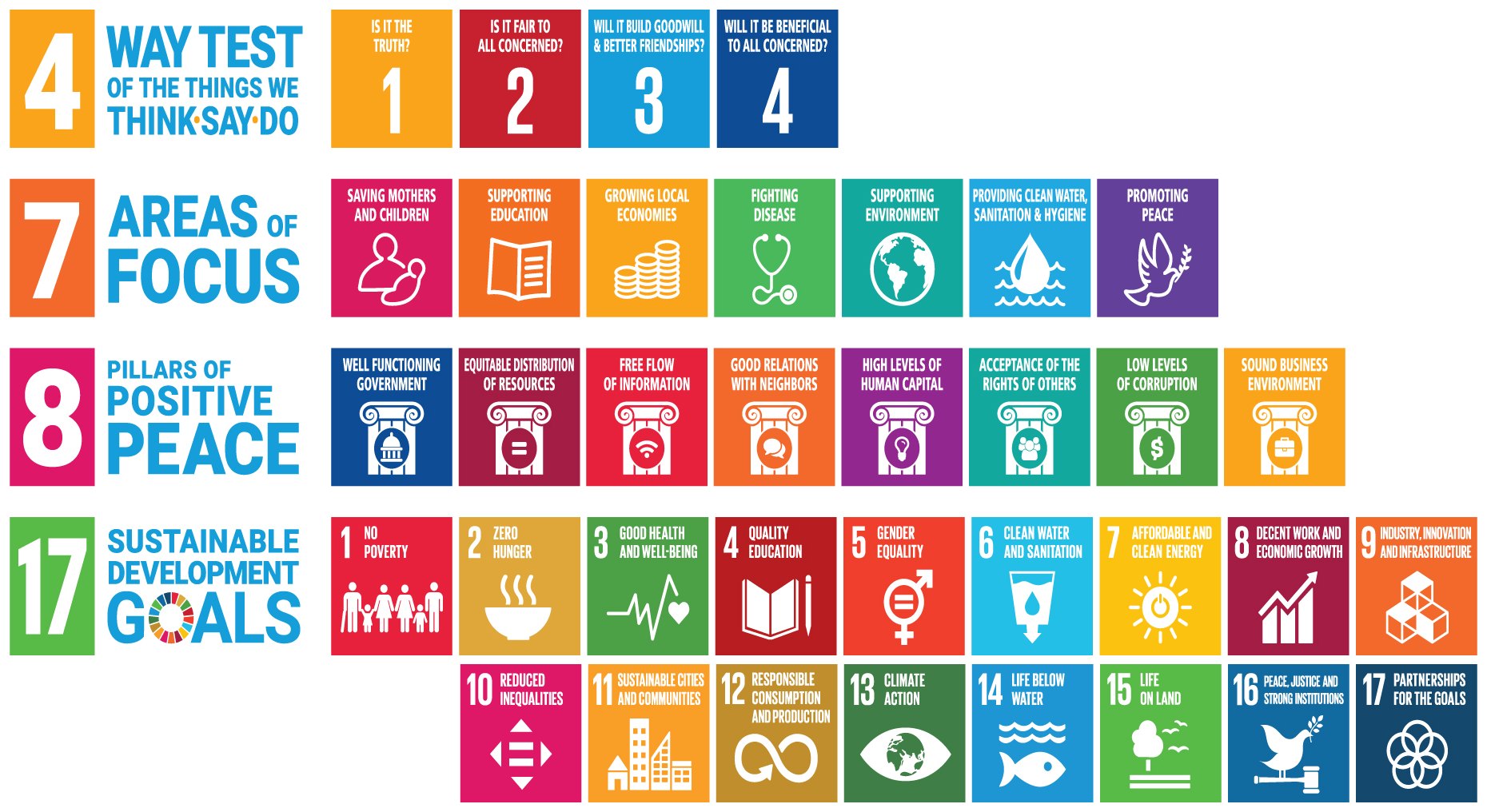
4-7-8-17 Report Card: Experiencia Ambientalia, Laguna Mar Chiquita, Argentina
- Four-Way Test passed
- 4 of 4
- Areas of Focus
- 4 of 7
- Pillars of Positive Peace
- 5 of 8
- UN SDGs
- 8 of 17
Four-Way Test
- Pass Is it the truth? Grounded in field science and measured results: 800+ participants and 78 projects since 2021.
- Pass Is it fair to all concerned? Free, inclusive participation that prioritizes rural, Indigenous and low-income youth.
- Pass Will it build goodwill and better friendships? Builds friendships across towns and countries through exchanges with sister saline lakes.
- Pass Will it be beneficial to all concerned? Benefits the wetland, local schools, youth leaders and conservation partners.
Rotary Areas of Focus
- Supporting Environment: Protects Laguna Mar Chiquita, a Ramsar wetland with more than 380 bird species.
- Supporting Education: Place-based environmental education and leadership training for students and teachers.
- Promoting Peace: Cross-cultural exchanges and shared stewardship build understanding and common purpose.
- Growing Local Economies: Youth-led projects include sustainable businesses and green entrepreneurship.
Pillars of Positive Peace
- High Levels of Human Capital: Builds leadership, ecological literacy and project design skills.
- Good Relations with Neighbors: International exchanges strengthen cooperation across the Americas.
- Free Flow of Information: Education and exchange platforms share knowledge between communities.
- Equitable Distribution of Resources: A fully funded program open to rural and Indigenous youth.
- Well-Functioning Government: Works alongside national park authorities and local governments.
UN Sustainable Development Goals
- SDG 4 Quality Education: Environmental education, systems thinking and place-based learning.
- SDG 6 Clean Water and Sanitation: Protects a globally important wetland and its water.
- SDG 13 Climate Action: Builds local capacity for climate-resilient territories.
- SDG 15 Life on Land: Conserves wetland habitat and migratory shorebirds.
- SDG 10 Reduced Inequalities: Opens leadership opportunities to rural and Indigenous youth.
- SDG 11 Sustainable Cities and Communities: Strengthens resilient, engaged communities around the lake.
- SDG 16 Peace, Justice and Strong Institutions: Encourages youth participation in community decision-making.
- SDG 17 Partnerships for the Goals: Partners across organizations, governments and countries.
Easy upgrades
- Have student teams monitor the lake's water quality to add Providing Clean Water, Sanitation and Hygiene.
- Track the green businesses youth launch to add Sound Business Environment.
- Publish yearly program budgets and results to add Low Levels of Corruption.
Rated with the 4-7-8-17 framework, and reviewed by the 100 Projects in 100 Countries team.
Is your club or community running a project like this? Share it and get your own 4-7-8-17 Report Card.
Submit your project