Re|Root Collaborative turns discarded textiles in Kumasi, Ghana into locally made goods while training women in upcycling, business and leadership skills. Its first workshops kept about 500 kg of textile waste out of dumpsites and fires.
Project Objective
The Re|Root Collaborative exists to turn global waste into local renewal by partnering with local changemakers to collect, repurpose, and recycle materials, reshaping the systems that connect us all. Re|Root aims to see healthy, inclusive communities where underemployed working-class individuals are empowered to lead and participate in sustainable local economies that protect public and environmental health.
Executive Summary
Re|Root Collaborative is a Ghana-based circular economy initiative that aims to reroute waste and improve health through community-centered recovery efforts, skills development, and product innovation. Operating in Kumasi, we transform discarded textiles into locally produced goods while equipping women with technical, entrepreneurial, and leadership skills. Additionally, we are working towards the development of a land repurposing model whereby informal dumpsites are turned into usable community "green spaces". By integrating environmental sustainability with income generation, Re|Root builds localized systems that reduce waste, strengthen livelihoods, and promote climate resilience.
Background
Ghana receives an estimated 15 million garments per week through secondhand clothing imports, with a significant portion ending up burned or in landfills and waterways. In parallel, women and youth in urban and peri-urban communities face high unemployment and limited access to sustainable income opportunities. Existing waste management systems lack infrastructure for textile recovery and community-based processing along with widespread reliable waste management systems.
Re|Root was created to bridge this gap by building decentralized textile recovery hubs that combine waste diversion with vocational skill-building and small-scale manufacturing.
Implementation Plan
Re|Root is working to establish a main operational hub in Kumasi where staff can work out of and in-house textile collection, washing, and upcycling can take place. There, we can sort and process discarded textiles for reuse or upcycling. Re|Root also aims to train cohorts of women in product design, sewing, and quality control and develop market-driven products for schools, hospitals, and community institutions. Funds generated from sales of upcycled products would be fully reinvested into expanding collection, increasing hiring and training, and subsidizing donations of upcycled products.
Outcomes
Re|Root's first textile upcycling workshops was able to divert approximately 500 kg of textile waste from informal dumping sites and burning. This textile was is in the process of being converted into usable upcycled products such as pillows, doormats, bags, and face towels. Over Re|Root's first full year of operating, it aims to support 20-30 women in circular production skills, assist with income generation efforts for participating women, and establish long-standing partnerships with academic and governmental institutions.
Partnerships
Re|Root collaborates with local recycling initiatives in Kumasi, educational institutions such as Kumasi Technical University and Kwame Nkrumah University of Science and Technology, and community-based organizations to strengthen infrastructure and market access. These partnerships enable resource sharing, technical training, and sustainable scaling.
Sustainability Vision
Re|Root’s long-term vision is to support practical, community-led environmental solutions in Kumasi. While our starting point is textile recovery, we see this as part of a much larger effort to rethink how waste and underused spaces are managed at the local level.
Beyond textiles, we are in early conversations about the possibility of repurposing large informal dump sites in Kumasi where communities of people live near or on top of. While still exploratory, this idea reflects our broader commitment to turning neglected waste spaces into productive, community-centered environments.
As our programs develop, we also aim to integrate low-impact production practices, including energy-efficient equipment and eventually small-scale solar power to reduce reliance on inconsistent grid electricity. Our goal is to build systems that are environmentally responsible, locally owned, and adaptable over time.
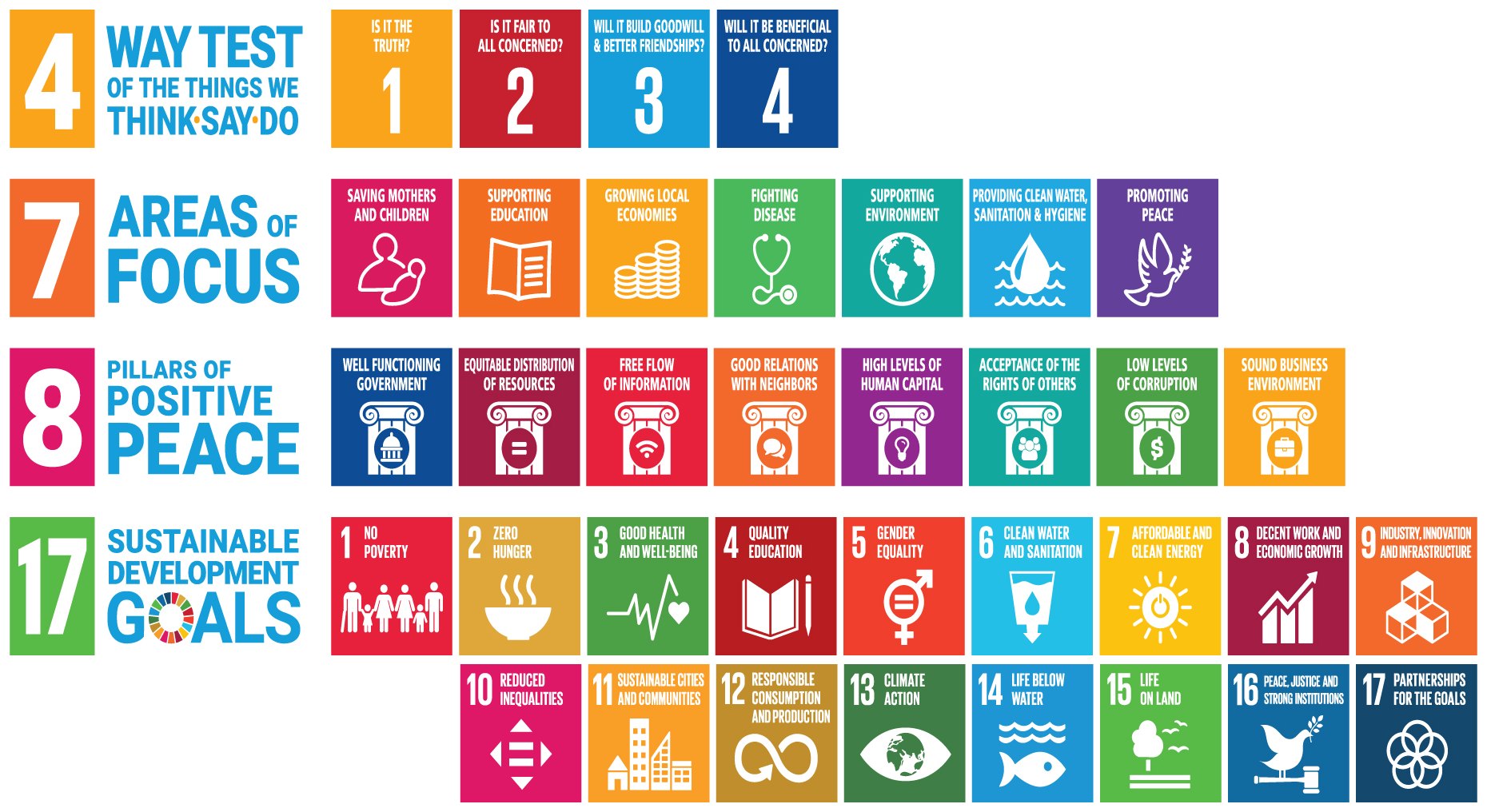
4-7-8-17 Report Card: Re|Root Collaborative, Kumasi, Ghana
- Four-Way Test passed
- 4 of 4
- Areas of Focus
- 4 of 7
- Pillars of Positive Peace
- 4 of 8
- UN SDGs
- 4 of 17
Four-Way Test
- Pass Is it the truth? Grounded in measured results, such as about 500 kg of textile waste kept out of dumpsites and fires in the first workshops.
- Pass Is it fair to all concerned? Focuses on underemployed, working-class women and reinvests sales into more jobs and training.
- Pass Will it build goodwill and better friendships? Builds partnerships with local recyclers, Kumasi Technical University, KNUST and community groups.
- Pass Will it be beneficial to all concerned? Cleaner neighborhoods, less waste burning, and new income and skills for local women.
Rotary Areas of Focus
- Supporting Environment: Keeps textile waste out of dumpsites and fires, and is developing a model to turn informal dumpsites into community green spaces.
- Growing Local Economies: Creates income for women and youth through upcycled products, with sales reinvested in hiring and training.
- Supporting Education: Hands-on vocational training in textile recovery, product design, sewing and entrepreneurship.
- Fighting Disease: Less open burning and dumping means less smoke, fewer blocked drains and fewer breeding grounds for disease.
Pillars of Positive Peace
- High Levels of Human Capital: Builds technical, entrepreneurial and leadership skills for women.
- Sound Business Environment: Builds small-scale circular manufacturing and market-driven products for local institutions.
- Equitable Distribution of Resources: Focuses on underemployed, working-class women who lack steady income.
- Good Relations with Neighbors: Works with local recyclers, Kumasi Technical University, KNUST and community organizations.
UN Sustainable Development Goals
- SDG 4 Quality Education: Hands-on vocational training in textile recovery, product development and entrepreneurship.
- SDG 7 Affordable and Clean Energy: Exploring small-scale solar to power sewing machines and textile processing equipment.
- SDG 8 Decent Work and Economic Growth: Creates income-generating opportunities for women and youth through circular production.
- SDG 17 Partnerships for the Goals: Partners with local leaders, universities and community institutions to strengthen value chains.
Easy upgrades
- Publish quarterly results, such as kilograms diverted and women trained, to add Free Flow of Information.
- Name women's economic empowerment as a goal to add SDG 5 Gender Equality.
- Report the textiles kept in use to add SDG 12 Responsible Consumption and Production.
Rated with the 4-7-8-17 framework, and reviewed by the 100 Projects in 100 Countries team.
Is your club or community running a project like this? Share it and get your own 4-7-8-17 Report Card.
Submit your project